
The latest macro-economic numbers confirm the economy trundles along in a low growth trajectory, while inflation climbs.

Leading indicators suggest economic activity has been disrupted after demonetisation.

The agency has kept its FY15 growth forecast unchanged at 5.6 per cent.

High inflation print is the price that the Reserve Bank of India (RBI) will have to pay to nurse a fragile growth back, say economists. Wholesale Price Index-based inflation rose to a record high of 12.94 per cent in May, aided by low base effect, but also because of higher fuel and commodity prices. Retail inflation, too, surprised by rising to 6.30 per cent, while the core inflation, which is the non-food and non-fuel component, rose to an 83-month high of 6.55 per cent. These numbers are much above RBI's upper limit of 6 per cent inflation target, but there is very little that the RBI can do at this moment.

Business houses expect rate cut in next RBI policy.

Even US equities are now back to end-2014 levels.

The economists, who were surveyed, also felt it will take time for banks to make any further reduction in deposit rates

Costlier vegetables slowly pushed retail inflation, which had remained well within the Reserve Bank's comfortable level of 4 per cent during most part of 2019, peaked to more than three-year high of 5.54 per cent in November.

The 30-share Sensex ended down 66 points at 28,438 and the Nifty ended down 15 points at 8,633.

Movement of rupee and crude oil prices will also dictate the trend
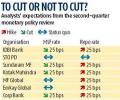
Analysts expect RBI to restore 100-bp corridor in Tuesday's policy review.

Bidders have to deposit a security fee of Rs 25 crore as well as minimum guarantee fee.

Sharp fall in capital goods production and manufacturing activity also dented sentiments.

Managing Brexit, inflation and banking reforms, along with the political environment, will be tough.
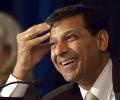
What differentiates Rajan from his predecessors is his proactive steps in anticipating a problem and coming up with out-of-the-box solutions

The industry has stepped up its demand for a rate cut
In recent past, midcap stocks have performed well, say experts.

Will give truer reflection on price movements of food products, impact of cereal procurement prices.
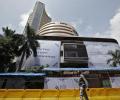
In the broader market, the S&P BSE Midcap added over 1% to finish at record closing high
Sensex has shed over 150 points in afternoon trade.

Metal stocks fell on Tuesday, with the S&P BSE metal index sliding 2.8 per cent compared to the 0.64 per cent fall in the benchmark S&P BSE Sensex

According to a new report published by Switzerland-based BIS, which is also referred as 'bank for central banks', the US Federal Reserve's announcement of a possible phasing out of easy money regime has resulted in 'abrupt and sizeable' equity market losses in both advanced and emerging markets.

The stock of the country's largest passenger vehicle maker, Maruti Suzuki India (MSIL), has been hitting successive all-time highs over the past three trading sessions. The rally in the scrip has helped it notch over a 21 per cent gain since the start of February, outperforming the National Stock Exchange Nifty Auto Index. The gains for the leader of small passenger cars have been more recent, as the company still trails the Nifty Auto over one- and two-year periods.

FY14 economic growth rate pegged at 4.8-5.3%, WPI inflation set to rise

A rate cut could stimulate demand and help revive industrial activity, without much risk of sparking off inflation again.
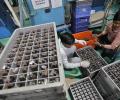
The automobile sector is considered a good indicator of economic health. It has a very long value chain, from primary materials, like metals, glass and plastic, to value-added high-end electronic components, specialised alloys, and software.

Vegetable, fruit prices to be on the rise over weak supply, crop damage
According to official figures, retail inflation in June touched its lowest mark at 7.31 per cent since January 2012.

Although the survey pointed to the softness in demand leveling off, a complete recovery is still some way off.

Investors turned cautious after India's trade deficit widened to a more than three-and-a-half-year high of $16.6 billion due to costlier crude oil imports

The global economy may just be entering a new phase.
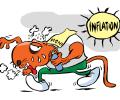
Don't be surprised if growth in the second half of the financial year drops below 4%, which is where it was in the year before the pandemic, warns T N Ninan.

On India achieving higher growth, Rajan said 9 per cent, which is the widely believed potential growth rate of the economy, is still some time away.

'So far, the government has sanctioned more than Rs 300 billion as GST refunds,' Ansh Bhargava and Aditya Singhania point out.

Markets extended gains for the fourth consecutive day tracking gains in banks, capital goods and oil and gas majors.

A rate cut will bring positive sentiment around the Budget.

The real requirement for the finance minister's explanatory speech is to explain the measures taken in the Budget to influence inflation and growth not just through the announcement of a deficit goal, but more broadly through the impact on money supply, consumer demand, foreign trade and investment, explains Nitin Desai.

RBI Governor Raghuram Rajan is regarded as credible by global financiers.

The Cabinet on Wednesday approved the National Mission on Edible Oils - Oil Palm (NMEO-OP) with a financial outlay of Rs 11,040 crore to promote domestic cultivation of oil palm in the next five years, and reduce the country's dependence on edible oil imports. The decision comes after Prime Minister Narendra Modi announced the new central scheme on August 15 during his Independence Day speech at Red Fort. Briefing the media, Union Information and Broadcasting Minister Anurag Thakur said the Cabinet approved the NMEO-OP with a focus on the northeast region and the Andaman and Nicobar Islands with a financial outlay of Rs 11,040 crore.
The RBI's macroeconomic report released after the close of markets said upside risks to food inflation remain and that it expects the retail and wholesale price inflation to remain above comfort levels.
